Ripco
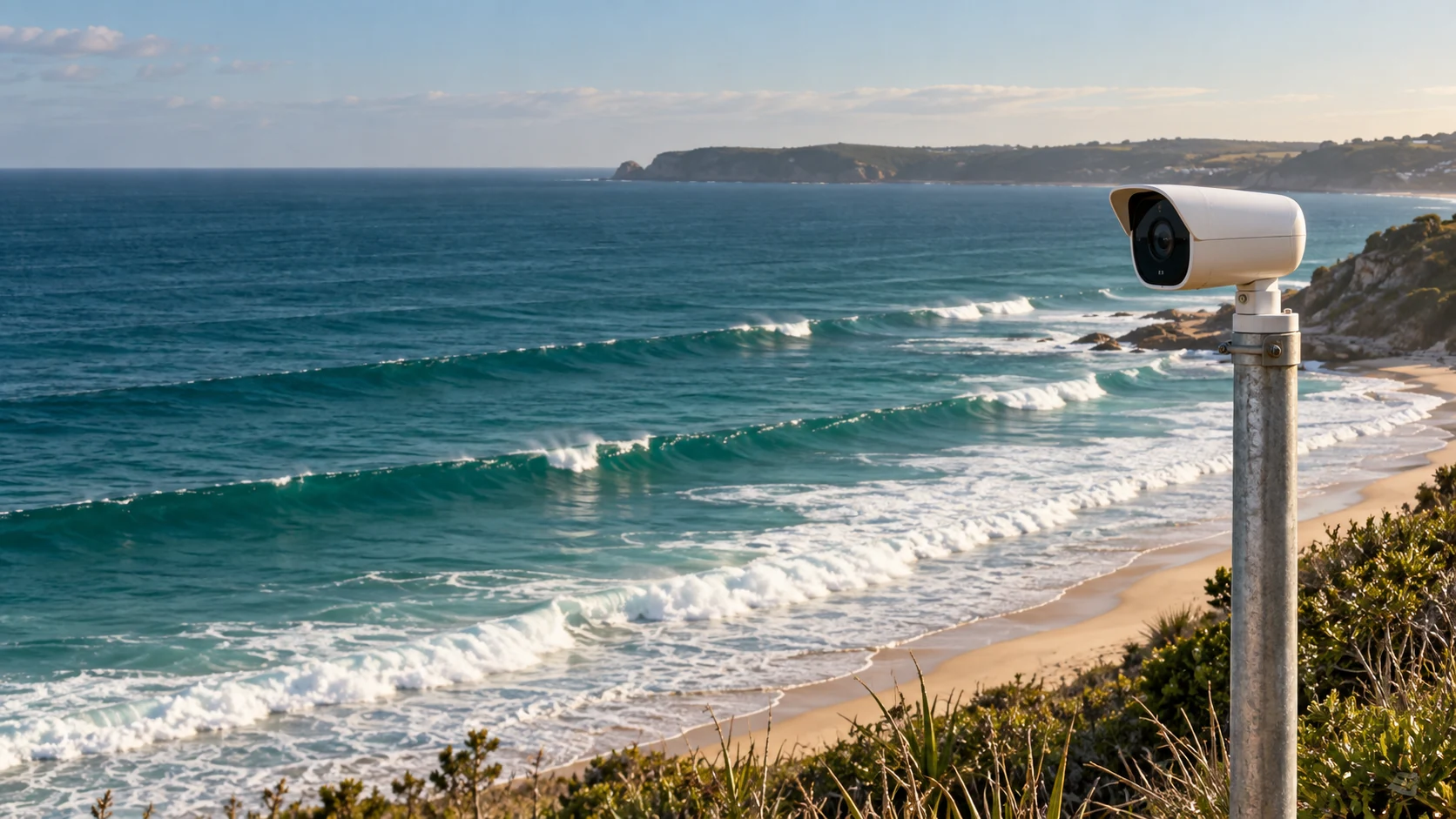
Illustrative coastal webcam overlooking the surf from a beach lookout
HOW RIPCO WORKS

A clearer view.
Before you go.

Beach cameras already watch the water.
RipCo looks for likely rip currents in that view
and brings the picture to your phone.

See it, step by step
01 The camera02 The model03 Your app
AI-created scene · illustrative camera
Follow the picture

One view.
Three useful steps.

Choose a step to see how the camera view becomes an extra layer of awareness. The diagram is a simplified example, not live detection.

Choose a step in the RipCo walkthrough
SIMPLIFIED VIEW FROM ABOVELikely rip Illustrative outline
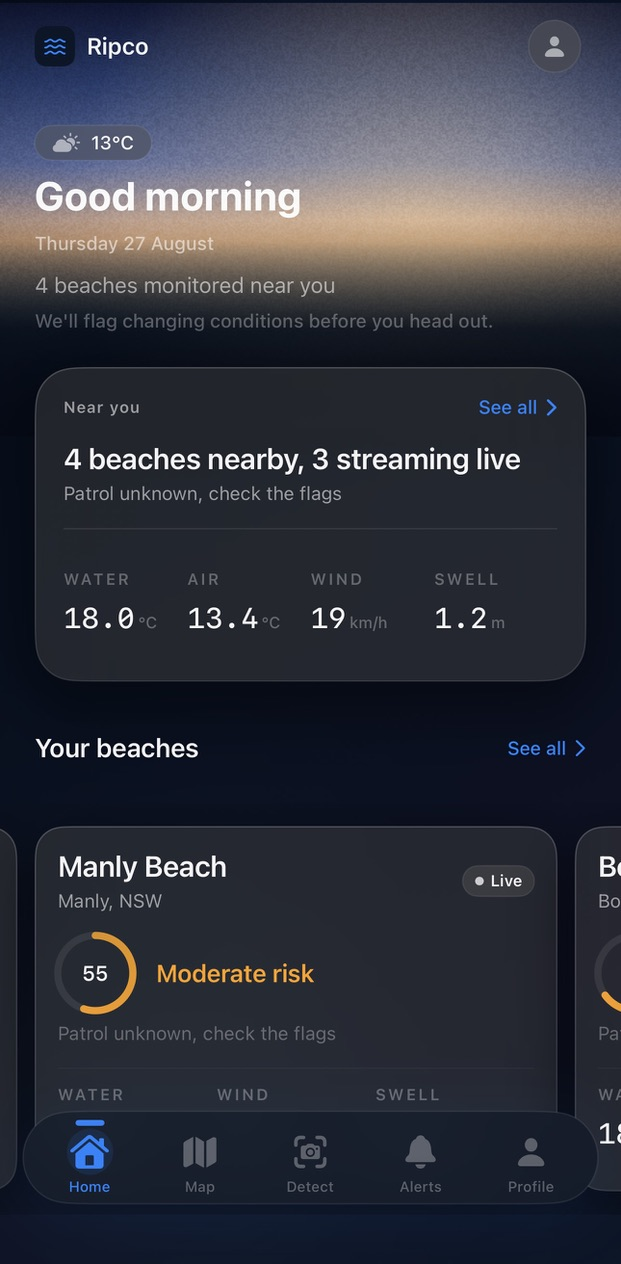
Actual RipCo home screen with nearby beaches, conditions, a risk label and the reminder to check the flags
More information.
Flags still come first.
Illustrated water movement · not a live camera feedIllustrative outline · not an actual model resultActual app screenshot · captured conditions, not live data
01 / OBSERVE

A view that
already exists.

RipCo uses a public beach camera looking out over the surf. No new camera or hardware is installed on the beach.

What the arrows showIn this simplified sandbar example, water moves along the shore and returns seaward through a channel.
Where we started
02 / INTERPRET

Looking for
what’s easy to miss.

The model analyses the camera image for signs of a rip. When it identifies a likely current, the Detect view can show an outline and a confidence figure.

A reading, not a guaranteeIt can miss a rip or outline something else. Confidence describes the model’s estimate for that outline.
Explore the visual clues
03 / UNDERSTAND

The bigger picture,
in your pocket.

Beach conditions, cameras and risk information sit together in the app. Detection is a separate view, available only where it has been tested.

This is the real home screenThe Manly card shown here has a Live camera badge. That badge does not mean rip detection is available there.
Explore the app screen

RipCo adds information. It never gives an all-clear to enter the water.

Reading the surface

The clues can
be surprisingly subtle.

These are some of the visual signs the model looks for. They can be hard to spot, and a rip will not always show every clue.

VISUAL CUE 01

A darker channel

Deeper water can look darker than the shallower water around it.
VISUAL CUE 02

A break in the waves

A gap in the breaking surf can be a clue. Smoother-looking water is not an all-clear.

VISUAL CUE 03

Water moving seaward

Foam, sand or debris moving away from shore can reveal the direction of flow.

Learn the signs. Keep following the flags and the patrol.

BeachSafe’s rip current guide
FROM THE REAL APP
Captured Manly Beach card showing 55, Moderate risk, a Live camera badge and Patrol unknown, check the flags
55 is the beach risk score.
It is not a detection confidence of 55%.

Owner-supplied screenshot. Captured values, not current conditions.

Know what you’re reading

Two readings.
Two different jobs.

01

The beach risk score

A number out of 100 on the beach card, accompanied by a risk label and conditions. It is separate from any rip outline.

02

Detection confidence

A percentage alongside an outline on the Detect screen. It reflects the model’s estimate for that possible rip, not whether swimming is safe.

Neither reading replaces the red and yellow flags or advice from the patrol.

Understanding the limits

A useful view.
Never the whole ocean.

A camera can only show so much. These are the situations where detection may be unavailable, incomplete or wrong.

VISIBILITY

When the image breaks down

Darkness, heavy rain and strong glare can make detection unavailable. Conditions may still be shown.

CAMERA ANGLE

What sits beyond the view

Small, distant or oblique rips can be missed. A camera only covers the part of the water it can see.

FALSE POSITIVES

An outline can be wrong

Shadows, weed and a lull between sets may be mistaken for a rip. A confidence figure does not remove that uncertainty.

CHANGING WATER

One moment is not the next

Rips can form, shift and fade as conditions change. An outline relates to the image being analysed.

Whatever the screen shows, swim between the red and yellow flags.
One coastline at a time

Start small.
Learn from the water.

Palm Beach is where the model was trained and tested. A single camera is a starting point, not proof it works at every beach.

Explore our coverage
PALM BEACH PILOTPrototype
Tested so far
Palm Beach camera footage
Other beaches
Conditions and cameras where available; detection is separate
Before expanding
New footage, camera access and testing for each location
App availability
In development · not yet on the App Store

Camera-use arrangements and a published test record remain part of the work before launch.

A little more detail

Good questions.
Straight answers.

What detection means, where it works and what to keep in mind.

How accurate is it?

The prototype can miss rips and produce false outlines. A confidence percentage is a model reading for one outline, not an independently measured accuracy rate. A published accuracy figure is not available on this site yet. See the pilot’s current scope.

Where has detection been tested?

At Palm Beach. Other beaches may have conditions and a streaming camera, but a Live badge does not mean detection has been tested there. Each new camera needs its own testing. Explore coverage.

What if the camera cannot see clearly?

Detection may be unavailable or unreliable in darkness, rain or glare. The app can still display conditions. Missing detection is never an all-clear.

Does the app need my location?

Location is optional in the app. Allow it to find nearby beaches, or choose a beach yourself. Read about privacy.

Can RipCo tell me it is safe to swim?

No. Use it for additional awareness. Swim between the red and yellow flags and follow the lifesavers and lifeguards on duty. Our safety commitment.

A few terms, explained
Rip current
Water flowing away from shore through the surf zone. Rips vary in shape and behaviour.
Feeders, neck and head
In a common sandbar rip, feeder currents gather water near shore, the neck carries it seaward, and the head spreads beyond the breakers.
Frame
One still image from the camera feed.
Confidence
The model’s estimate for a particular outline. It is not the probability that swimming is safe.
False outline / missed rip
An outline around something that is not a rip / a rip that the model does not outline.
Risk score
A separate number out of 100 on a beach card, labelled as a level of risk.
Live
The camera is streaming. This label does not confirm detection coverage.
Sets and lulls
Groups of waves and the quieter intervals between them.
MORE AWARE. BEFORE YOU’RE THERE.

Made to inform.
Never to give the all-clear.

Our safety commitment is part of every screen.